I want to talk to you about something real, because there is a lot of noise out there about equine therapy and wellness and what horses do for kids. Some of it is beautiful but vague. Some of it is marketing dressed up as research.
So let me give you the actual science.
A 2023 meta-analysis published in the Adolescent Research Review through Springer synthesized 16 peer-reviewed controlled studies with 1,009 youth participants. The effect size was d = 0.535, statistically significant at p less than 0.001. For context, the average effect size of standard school-based mental health interventions across 38 randomized controlled trials is d = 0.17.
Equine-assisted curriculum produces results that are more than three times more effective than what most schools are already doing.
That is not a claim I am making. That is the published science. The DOI is 10.1007/s10964-023-01789-4 if you want to look it up yourself.
Here is what that means in plain terms. More than 40% of U.S. high schoolers report persistent sadness or hopelessness, according to the CDC. 1 in 5 adolescents experiences a mental health condition every year. And the tools most schools have available (a counselor with a caseload of 400 students, a mindfulness app, a note home) are genuinely not moving the needle.
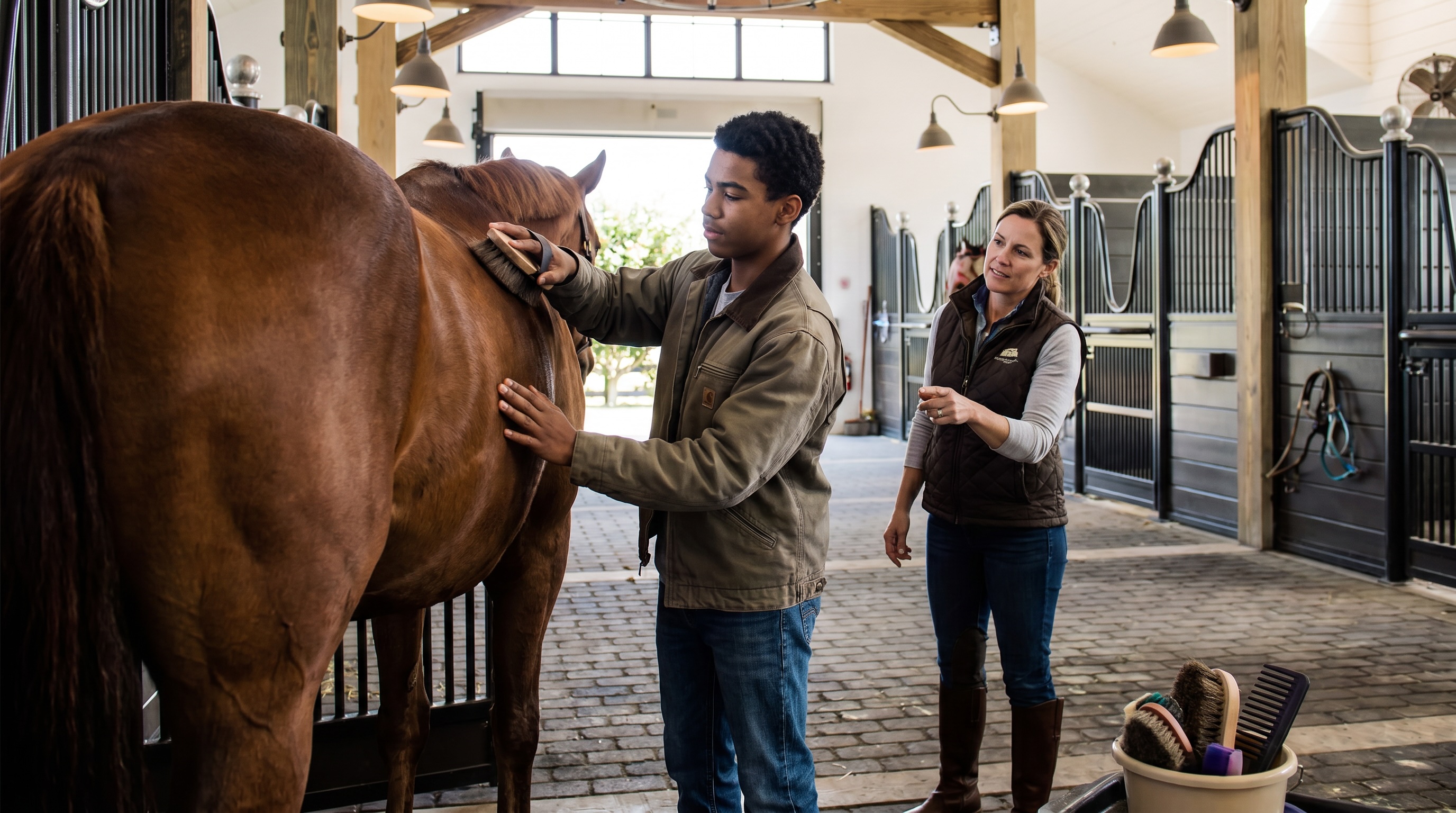
What moves the needle is daily responsibility for a living animal that cannot be faked. A horse gives us something to believe in that is greater than ourselves. They give us purpose. A horse responds to you. It mirrors your nervous system. It requires you to regulate before it will. That is not a metaphor. It is documented physiology.
At EACPA, wellness is not a program we added. It is baked into the structure of every school day. Seven AM barn rotation. Responsibility before academics. A student who has already spent two hours with a 1,200-pound animal that depends on her walks into a classroom with a nervous system that has been regulated in a way no meditation app can replicate.
The barn is not the reward. It is the classroom.
If you are a parent watching your teenager struggle and wondering if there is an environment better designed for who they are, I want you to know: the science says yes. And EACPA is building that environment right now.
Laura Bruner, Founder